
Choosing the right filament is one of the most important decisions you’ll make before starting a 3D print.
PLA, PETG, and ABS are three of the most widely used materials in FDM 3D printing. They may look similar on a spool, but their properties can produce very different results.
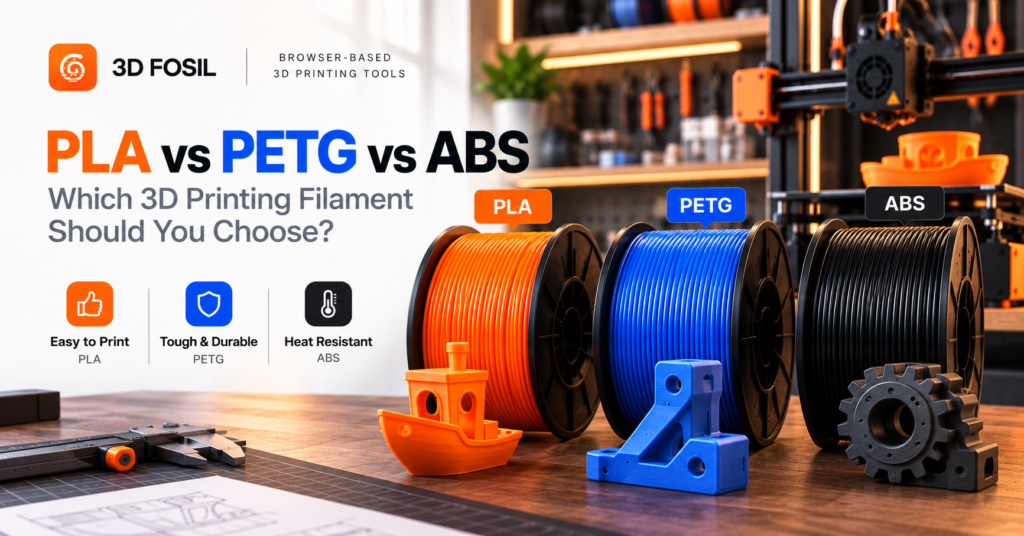
PLA is known for its ease of printing and clean surface finish. PETG offers a useful balance of toughness and printability. ABS is often selected for functional parts that require higher temperature resistance.
So, which one should you use?
For beginners and decorative prints, PLA is usually the best choice. PETG is a practical option for tougher functional parts, while ABS is better suited to certain heat-resistant applications when your printer and workspace can handle its requirements.
The best material ultimately depends on what you’re printing, how the part will be used, and the capabilities of your 3D printer.
In this guide, we’ll compare PLA, PETG, and ABS across their most important characteristics, explain their advantages and limitations, and help you choose the right filament for your next project.
What Are PLA, PETG, and ABS?
PLA, PETG, and ABS are thermoplastic materials used in FDM (Fused Deposition Modeling) and FFF (Fused Filament Fabrication) 3D printing.
They soften when heated and solidify as they cool, allowing a 3D printer to build objects layer by layer.
However, their chemical structures and physical properties are different.
What Is PLA Filament?
PLA (Polylactic Acid) is a thermoplastic commonly produced from renewable feedstocks such as corn starch or sugarcane.
It is one of the most popular materials for desktop 3D printing because it generally requires less demanding printing conditions than many engineering plastics.
PLA is commonly used for:
- Decorative objects and figurines
- Miniatures and display models
- Educational projects
- Concept prototypes
- General-purpose household objects
Its main advantages are easy printing, relatively low warping, and good dimensional accuracy.
However, standard PLA has limited heat resistance and may become brittle under certain conditions.
A PLA part left inside a hot vehicle, for example, may soften or deform.
What Is PETG Filament?
PETG (Polyethylene Terephthalate Glycol-Modified) is a thermoplastic polyester known for its toughness, chemical resistance, and relatively accessible printing requirements.
PETG is often chosen when PLA does not provide enough durability for a particular application.
Common PETG applications include:
- Functional brackets
- Protective covers
- Storage accessories
- Mechanical prototypes
- Utility components
- Parts exposed to occasional moisture
PETG generally offers better toughness than standard PLA and is less prone to brittle fracture.
However, it can be more difficult to tune because of stringing, surface artifacts, and strong adhesion to certain build plates.
What Is ABS Filament?
ABS (Acrylonitrile Butadiene Styrene) is an engineering thermoplastic widely used in manufactured products.
It is valued for its toughness, impact resistance, and ability to withstand higher temperatures than standard PLA.
ABS is commonly used for:
- Mechanical housings
- Functional prototypes
- Automotive interior components
- Tool enclosures
- Electronic equipment housings
- Parts requiring post-processing
ABS can be an excellent choice for functional components, but it is generally more difficult to print.
It is prone to warping and typically benefits from an enclosed printing environment.
ABS printing also requires appropriate ventilation and exposure controls because heated ABS can release ultrafine particles and volatile compounds.
PLA vs PETG vs ABS: Quick Comparison
Before examining each material in detail, here’s a practical overview.
| Property | PLA | PETG | ABS |
|---|---|---|---|
| Printing Difficulty | Easy | Easy–Moderate | Moderate–Hard |
| Typical Nozzle Temperature | 190–220°C | 220–250°C | 230–260°C |
| Typical Bed Temperature | 45–65°C | 65–85°C | 90–110°C |
| Heat Resistance | Low | Moderate | Good |
| Impact Toughness | Moderate; can be brittle | Generally good | Generally good |
| Stiffness | Generally high | Moderate | Moderate |
| Warping Risk | Low | Low–Moderate | High |
| Stringing Risk | Low–Moderate | Moderate–High | Moderate |
| Enclosure Required | Usually no | Usually no | Strongly recommended |
| Outdoor Suitability | Limited | Moderate | Limited without protection |
| Beginner Friendly | Excellent | Good | Limited |
| Typical Applications | Models and prototypes | Functional parts | Heat-resistant components |
These are general comparisons. Actual performance depends on the filament manufacturer, formulation, print orientation, layer adhesion, and printing conditions.
PLA vs PETG vs ABS: Which Is Stronger?
One of the most common questions in 3D printing is whether PLA, PETG, or ABS is the strongest filament.
The answer depends on what you mean by strength.
A material can be strong in tension but brittle under impact. Another material may be more flexible and absorb impacts without breaking.
Tensile Strength
Tensile strength describes how much pulling stress a material can withstand before failure.
PLA can provide relatively high tensile strength and stiffness under suitable conditions.
PETG and ABS may have different tensile properties depending on their formulations.
This means PLA is not automatically weaker than PETG or ABS in every mechanical test.
Impact Resistance
Impact resistance describes how well a material absorbs sudden forces.
PETG and ABS generally provide better impact toughness than standard PLA.
For parts that may be dropped, bumped, or subjected to repeated handling, toughness can be more important than stiffness.
Layer Adhesion
In FDM printing, a part’s mechanical performance depends heavily on how well the printed layers bond together.
Layer adhesion is influenced by:
- Nozzle temperature
- Cooling
- Print speed
- Material condition
- Layer height
- Print orientation
A poorly printed ABS part may be weaker than a well-printed PLA part.
Similarly, PETG printed with unsuitable settings may not achieve its expected mechanical properties.
Which Filament Should You Choose for Strong Parts?
For rigid components that experience limited impact, PLA may be sufficient.
For parts requiring greater toughness, PETG is often a practical option.
For components exposed to higher temperatures, ABS may be more suitable.
The strongest filament is not necessarily the best filament for every application.
Material selection should be based on the actual mechanical and environmental requirements of the part.
PLA vs PETG vs ABS: Heat Resistance
Heat resistance is one of the most important differences between these materials.
A printed object may perform well at room temperature but deform when exposed to elevated temperatures.
For example, a dashboard accessory inside a parked vehicle may experience significantly higher temperatures than an object used indoors.
PLA Heat Resistance
Standard PLA has relatively low heat resistance.
Its glass transition temperature is commonly around 55–65°C, although this varies by formulation.
Near this temperature range, PLA can begin losing stiffness and may deform under load.
This makes standard PLA a poor choice for many applications involving sustained heat.
PETG Heat Resistance
PETG generally offers better heat resistance than standard PLA.
Its glass transition temperature is commonly around 75–85°C.
PETG can be useful for applications involving moderately elevated temperatures.
However, it can still deform when exposed to sufficient heat and mechanical stress.
ABS Heat Resistance
ABS typically has a glass transition temperature around 100–110°C.
This provides greater temperature resistance than standard PLA and PETG.
ABS is therefore commonly used for functional components that may experience higher temperatures.
Heat Resistance Comparison
| Material | Approximate Glass Transition Temperature |
|---|---|
| PLA | 55–65°C |
| PETG | 75–85°C |
| ABS | 100–110°C |
Important: Glass transition temperature is not the same as a part’s guaranteed operating temperature.
Actual heat resistance depends on the material grade, load, geometry, print settings, and duration of exposure.
For applications involving heat and mechanical stress, consult the filament manufacturer’s technical data sheet.
Which Filament Is Easiest to Print?
For most beginners, PLA is the easiest of the three materials to print.
Printing With PLA
PLA generally requires lower nozzle temperatures and is less prone to warping.
Many printers can produce good PLA results without an enclosure.
PLA also tends to provide consistent surface detail, making it suitable for decorative models and prototypes.
Printing With PETG
PETG is usually more demanding than PLA but easier to manage than ABS.
Common challenges include:
- Stringing
- Excessive build plate adhesion
- Surface imperfections
- Temperature sensitivity
PETG may require additional tuning of nozzle temperature, retraction, cooling, and travel settings.
Once properly configured, it can produce durable functional parts.
Printing With ABS
ABS is generally the most challenging of the three materials.
It contracts significantly as it cools, which can lead to:
- Warping
- Corner lifting
- Layer separation
- Cracking
- Dimensional inaccuracies
An enclosed printer helps maintain a more stable thermal environment.
Proper ventilation and exposure controls are also important when printing ABS.
Printing Difficulty Ranking
For typical consumer FDM printing:
PLA → PETG → ABS
This is a useful general guideline, although specialized filament formulations and printer capabilities can change the experience.
PLA vs PETG vs ABS: Print Quality and Surface Finish
All three materials can produce high-quality prints, but they have different characteristics.
PLA Surface Quality
PLA is often preferred for models where visual appearance and fine detail are important.
It generally offers:
- Good dimensional accuracy
- Clean surface detail
- Limited warping
- Consistent printing results
PLA is especially popular for figurines, decorative objects, and display models.
PETG Surface Quality
PETG can produce attractive prints, but stringing and surface artifacts may require additional tuning.
Depending on the filament, PETG may have a glossy appearance.
It can be useful for functional objects where toughness is more important than achieving the finest decorative finish.
ABS Surface Quality
ABS can produce good surface quality when printed under controlled conditions.
However, warping and thermal contraction can affect dimensional accuracy.
One advantage of ABS is that suitable parts can be chemically smoothed using controlled post-processing methods.
Such processes require appropriate safety precautions and should not be treated as routine household operations.
PLA vs PETG vs ABS: Which Is Best for Outdoor Use?
Outdoor applications introduce additional challenges.
Printed parts may be exposed to:
- Sunlight
- Ultraviolet radiation
- Temperature changes
- Rain and humidity
- Mechanical stress
PLA Outdoors
Standard PLA is generally not the best choice for long-term outdoor applications.
Its relatively low heat resistance can be problematic in direct sunlight or hot environments.
PETG Outdoors
PETG is often a better choice than standard PLA for certain outdoor applications.
It generally offers improved toughness and useful moisture resistance.
However, long-term UV performance varies by formulation.
ABS Outdoors
ABS offers good mechanical and thermal properties, but prolonged UV exposure can cause degradation, discoloration, and loss of mechanical performance.
For applications requiring long-term outdoor durability, ASA is often a better alternative to standard ABS.
Best Choice for Outdoor Parts
Among PLA, PETG, and ABS, PETG can be a practical option for many outdoor projects.
However, ASA is often preferable when long-term UV and weather resistance are primary requirements.
Always consider the specific environment and material formulation.
PLA vs PETG vs ABS: Printing Temperatures
Choosing suitable temperatures is essential for successful printing.
The following ranges are common starting points.
| Setting | PLA | PETG | ABS |
|---|---|---|---|
| Nozzle Temperature | 190–220°C | 220–250°C | 230–260°C |
| Bed Temperature | 45–65°C | 65–85°C | 90–110°C |
| Part Cooling | Usually high | Moderate | Usually limited |
| Enclosure | Usually unnecessary | Optional | Strongly recommended |
These values are illustrative.
For example, some high-speed PLA formulations require higher temperatures than standard PLA.
Similarly, specialty PETG and ABS products may have different recommendations.
Always use the filament manufacturer’s specifications as your primary reference.
PLA vs PETG vs ABS: Cost Comparison
Filament prices vary depending on the manufacturer, quality, formulation, and region.
Standard PLA is often competitively priced because it is widely produced and available.
PETG and ABS may have similar or somewhat different prices depending on the brand.
However, spool price alone doesn’t determine the total cost of a 3D print.
You should also consider:
- Material consumption
- Printing time
- Electricity usage
- Support material
- Failed prints
- Post-processing
- Equipment requirements
For example, ABS may require an enclosure and additional environmental controls.
PETG may require more tuning than PLA for certain models.
A lower filament price doesn’t always result in a lower total production cost.
How to Estimate Printing Costs
A simplified material cost calculation is:
Material Cost = Filament Used (g) × Cost per Gram
For example, suppose a 1 kg spool costs $20.
The material cost per gram is:
$20 ÷ 1,000 = $0.02
If your model requires 75 grams of filament:
75 × $0.02 = $1.50
The estimated filament cost would be $1.50, excluding additional expenses.
Estimate Material Usage With 3D Fosil
3D Fosil includes online slicing tools that help users evaluate printing requirements.
By selecting a printer profile, configuring material settings, and slicing a model, users can review available estimates for material consumption, printing time, and cost.
This can help when comparing different configurations before printing.
Which Filament Should You Choose for Different Projects?
The best filament depends on the intended use of your printed object.
| Project | Recommended Starting Material | Reason |
|---|---|---|
| Decorative figurines | PLA | Easy printing and good detail |
| Miniatures | PLA | Consistent surface quality |
| General prototypes | PLA | Convenient and accessible |
| Functional brackets | PETG | Useful toughness |
| Storage accessories | PLA or PETG | Depends on mechanical requirements |
| Protective covers | PETG | Impact toughness |
| Heat-exposed housings | ABS | Higher temperature resistance |
| Automotive interior parts | ABS | Better heat resistance than standard PLA |
| Outdoor brackets | PETG or ASA | Depends on UV and temperature exposure |
| Mechanical enclosures | PETG or ABS | Depends on operating conditions |
These recommendations are starting points.
For critical components, evaluate the actual mechanical, thermal, and environmental requirements before selecting a material.
How Filament Choice Affects Slicing Settings
Changing filament materials requires more than replacing the spool.
Each material has different printing requirements.
For example, a slicing profile configured for PLA may use cooling and temperature settings that are unsuitable for ABS.
Before generating G-code, verify:
- Nozzle temperature
- Bed temperature
- Print speed
- Cooling configuration
- Retraction settings
- Build plate adhesion
- Enclosure requirements
- Printer and material compatibility
Prepare Your Models With 3D Fosil
3D Fosil provides browser-based STL analysis and online slicing tools.
You can upload your model, select a supported printer profile, configure printing parameters, and generate G-code without installing traditional desktop slicing software.
The platform also includes tools for reviewing model printability and estimating printing requirements.
Whether you’re using PLA, PETG, or ABS, selecting appropriate material settings is an important part of preparing your print.
Common Problems With PLA, PETG, and ABS
Each filament has its own typical printing challenges.
PLA: Heat Sensitivity and Brittleness
PLA can deform when exposed to elevated temperatures.
Some PLA formulations can also fracture under impact or repeated stress.
What to do: Use PLA for applications that match its thermal and mechanical limitations. Consider PETG or another suitable material when additional toughness is required.
PETG: Stringing and Surface Artifacts
PETG can produce thin strands between separate parts of a print.
What to do: Review nozzle temperature, retraction, travel settings, and filament moisture condition.
ABS: Warping and Layer Separation
ABS contracts significantly during cooling.
This can cause corners to lift from the build plate or layers to separate.
What to do: Use a suitable enclosure, maintain appropriate temperatures, improve build plate adhesion, and avoid sudden cooling.
Frequently Asked Questions
Is PETG stronger than PLA?
PETG is generally tougher and less brittle than standard PLA, but PLA can offer greater stiffness and competitive tensile strength. The better material depends on the type of mechanical load.
Is ABS stronger than PETG?
Neither material is universally stronger. ABS and PETG have different mechanical characteristics, and actual performance depends on formulation, print orientation, and printing conditions.
Which filament is best for beginners?
PLA is usually the best starting point because it is relatively easy to print and generally requires less demanding temperature control.
Is PLA or PETG better for functional parts?
PETG is often preferred for functional parts that require additional toughness. PLA may still be suitable for rigid parts used at moderate temperatures.
Can PLA withstand heat?
Standard PLA has limited heat resistance and may soften or deform at elevated temperatures, particularly under mechanical load.
Does ABS require an enclosure?
ABS generally benefits from an enclosure because stable temperatures help reduce warping and layer separation.
Is PETG waterproof?
PETG material has useful moisture resistance, but a 3D printed PETG object is not automatically watertight. Print settings, layer adhesion, geometry, and sealing can affect water resistance.
Which filament is best for outdoor use?
PETG can work for many outdoor applications, but ASA is often a better option when long-term UV and weather resistance are important.
Which filament produces the best print quality?
PLA is often the easiest material for achieving clean surface detail with minimal tuning. PETG and ABS can also produce high-quality prints when configured correctly.
Can I use the same slicing settings for PLA, PETG, and ABS?
No. These materials have different temperature, cooling, and printing requirements. Use suitable material profiles and adjust settings according to the filament manufacturer’s recommendations.
Final Verdict: PLA, PETG, or ABS?
There is no single filament that is best for every 3D printing project.
Each material has strengths and limitations.
Choose PLA if:
- You’re new to 3D printing.
- You want reliable results with minimal tuning.
- You’re printing decorative objects, miniatures, or general prototypes.
Choose PETG if:
- You need greater toughness.
- You’re printing functional parts.
- You want a balance between durability and printing convenience.
Choose ABS if:
- Your parts require higher temperature resistance.
- You have a printer and workspace suitable for ABS.
- You’re producing functional components that benefit from its properties.
The most important step is matching the filament to the requirements of your project.
Once you’ve selected your material, make sure your model and slicing settings are properly configured.
With 3D Fosil, you can analyze STL files, configure printing parameters, and generate G-code directly from your browser.
Choose your material. Prepare your model. Print with confidence.
Explore 3D Fosil at 3dfosil.com.